
If you’ve got a leaning tree, you’ve probably already heard three different opinions. A neighbor says it’s “been like that forever.” Someone else says it’s going to fall tomorrow. Online answers swing between “stake it” and “cut it down.”
That confusion makes sense because not every lean is the same. Some trees adjust over time and remain stable. Others are telling you the root system is failing, and the timeline can be short.
This guide is here to help you make a safe call based on what professionals look for, without panic and without guesswork.
Why leaning trees create so much mixed advice
A lean can come from normal growth patterns, past wind exposure, poor planting, or soil changes. It can also come from damage you can’t fully see, like root breakage or a shifting root plate.
That’s why one person can look at the trunk angle and say “fine,” while another notices a clue at the base and says “not fine.” Risk is about more than the angle. It’s about what’s changing and what the tree could hit if it fails.
When you’re deciding what to do, you’re really balancing two things: safety now, and preventable costs later.
Should I remove a leaning tree
This is the moment most homeowners want a straight answer. Here’s the honest version: sometimes you can save it, and sometimes removal is the safest option. The difference comes down to stability and targets.
The two questions that matter most
First: Is the lean recent or increasing? A sudden lean is often linked to root weakening and can be a sign the tree should probably be removed.
Second: If it falls, what does it hit? A lean over a fence line, play area, driveway, or house carries a different risk than a lean into open space.
Quick risk tiers homeowners can understand
- Lower concern: The tree has leaned for years, and you can see “corrective” growth (the trunk or branches curve back upward).
- Higher concern: The lean is new, the ground is lifting near the base, or the lean worsened after storms or heavy rain.
- Urgent: The lean is new and the tree is close to structures, or there are fresh cracks, root movement, or major canopy damage.
This is also where a certified arborist’s risk process matters. The International Society of Arboriculture (ISA) publishes homeowner education and risk resources through TreesAreGood, which is a solid credibility reference when you want to understand how pros think about tree stability. https://www.treesaregood.org/
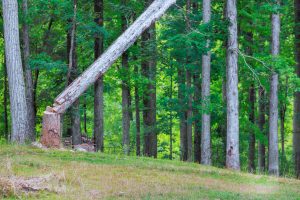
Leaning that’s often stable vs leaning that’s a warning
A lean is not automatically a death sentence. What matters is whether the tree has adapted, or whether the tree is actively losing its footing.
“It’s always leaned” and what to look for
If a tree has leaned for a long time, it may show growth patterns that suggest it has adjusted to the tilt. Educational tree stewardship materials note that long-term leaning may be relatively stable, while a recent or worsening lean is a concern.
You’ll often see the trunk curve, or the canopy “re-balance” itself. That doesn’t guarantee safety, but it’s very different from a tree that suddenly tips after a weather event.
Sudden lean after storms and saturated soil
A sudden tilt after a storm is one of the clearest signals that roots may have broken or lost hold. The University of Maryland Extension guidance flags sudden leaning as a sign the tree likely should be removed, and it even gives a practical threshold that a lean of more than about 15% from vertical is a serious concern.
Storm-related failures often show up as root plate movement, where the soil lifts or cracks near the base. That “heaving” is a classic warning sign that the anchoring system is shifting.
Signs a tree may be salvageable
A tree is more likely to be saved when the lean is tied to manageable causes and the foundation is still stable.
Here are cues that often lean toward “possible to correct,” depending on species, size, and site conditions:
- The tree is young (recently planted or small enough that support can help it re-establish).
- The lean is gradual, not sudden, and the trunk shows adaptive growth rather than fresh movement.
- The base of the tree is quiet: no lifting turf, no fresh soil cracking, no exposed roots that look newly shifted.
- The canopy is mostly intact, with no major split trunk or structural break that changes load distribution.
Even then, “salvageable” doesn’t mean “DIY fix.” It means the tree might be a candidate for professional stabilization, selective pruning, or corrected support.
Signs removal is usually the safer call
When trees fail, they often fail at the base or through a structural defect. You want to catch those signals early.
Watch for these stronger indicators:
- The lean is new, worsened quickly, or appeared after storms.
- The ground around the trunk shows root plate movement, like lifting, cracking, or a mound forming.
- There are fresh trunk cracks or splits, especially multiple cracks in the same area. Extension guidance notes cracks can be a serious defect and immediate action may be warranted in certain crack patterns.
- The tree has lost a large portion of its canopy or has a main stem defect that changes balance and wind load.
- The tree is leaning toward a home, parked vehicles, a neighbor’s yard, or a commonly used path.
If you’re seeing these signs, removal is often less about preference and more about reducing the chance of property damage or injury.

What not to do with a leaning tree
When people panic, they sometimes make the situation worse.
A few common missteps:
- Don’t keep “testing” the tree by pushing it. If roots are failing, movement can accelerate the problem.
- Don’t wrap chains or cables around the trunk and crank it tight. That can damage bark and create long-term decay entry points.
- Don’t assume a single stake fixes a mature tree. Staking is mainly for young trees and short-term support, not for stabilizing large trees with compromised roots.
If the tree is anywhere near power lines, treat it as a “call a pro first” situation.
Stabilizing younger trees the right way
If you’re dealing with a young tree that tipped or leaned, support can help in the right conditions. The goal is to help it re-establish, not to hold it rigid forever.
University guidance on staking and guying emphasizes using as few supports as needed, because trees often develop stronger trunks and roots when they’re not over-staked.
In practice, that usually means temporary support, periodic re-checks, and removing supports once stability returns. If the lean is tied to poor planting depth, compacted soil, or repeated wind exposure, a professional can address the underlying issue instead of just “straightening” the trunk.
Liability, neighbors, and peace of mind
Here’s the part nobody loves, but everybody thinks about: responsibility.
If a tree is visibly failing and it’s close enough to damage a neighbor’s property, waiting can create stress on both sides. Even if you’re not sure it’s “that bad,” a documented professional assessment can help you make a decision you can stand behind.
Think of it as risk management:
- Are there people or property in the fall zone?
- Is the lean changing?
- Are there base warning signs?
- Would you feel comfortable explaining your choice after a storm?
If the answer is no, it’s time for a closer look.
When to call 855TREEMAN in Southern Maryland
If your leaning tree is near a home, driveway, or shared property line, getting it assessed early is usually cheaper and calmer than waiting for the next storm to make the decision for you.
To learn more about services and coverage, visit 855TREEMAN tree services in Southern Maryland at https://855treeman.com/. When you’re ready, request a tree removal estimate here: https://855treeman.com/contact/.
FAQs
Can a leaning tree straighten itself over time?
Some trees can adapt gradually, especially if the lean develops slowly and the tree shows corrective growth patterns. A sudden lean is more concerning because it can indicate weakened roots.
How do I know if a lean is new or has been there for years?
Look for curved trunk growth or canopy growth that appears to “correct” upward over time. Recent leaning often comes with soil disturbance near the base or a noticeable change after storms.
Is a tree more likely to fall if the ground is wet?
Saturated soil can reduce root anchoring and increase the chance of wind-related failures. After heavy rain and wind, pay close attention to root plate movement and soil heaving.
Can I stake a leaning tree that’s already established?
Staking is generally intended for younger trees and short-term support. Over-staking can slow strong trunk and root development, and it’s not a reliable fix for large trees with root instability.
What’s the fastest sign a leaning tree may be unsafe?
A sudden lean, fresh cracks in the trunk, or lifting/cracking soil around the base are strong red flags and merit prompt professional assessment.